
REST API
View as MarkdownEverything the interface does goes through the REST API. Scripts and integrations use it with personal API tokens.
Base URL
Section titled “Base URL”Through the web container the API lives under /api:
https://infraward.example.com/apiAPI tokens
Section titled “API tokens”Create a token in Ajustes → Tokens de API (Settings → API tokens) with Nuevo token (New token). Choose:
- Alcance (Scope):
readallows onlyGETandHEADrequests.roleacts with your role’s permissions at the time of each request. - Caducidad (Expiry): mandatory, at most 365 days.
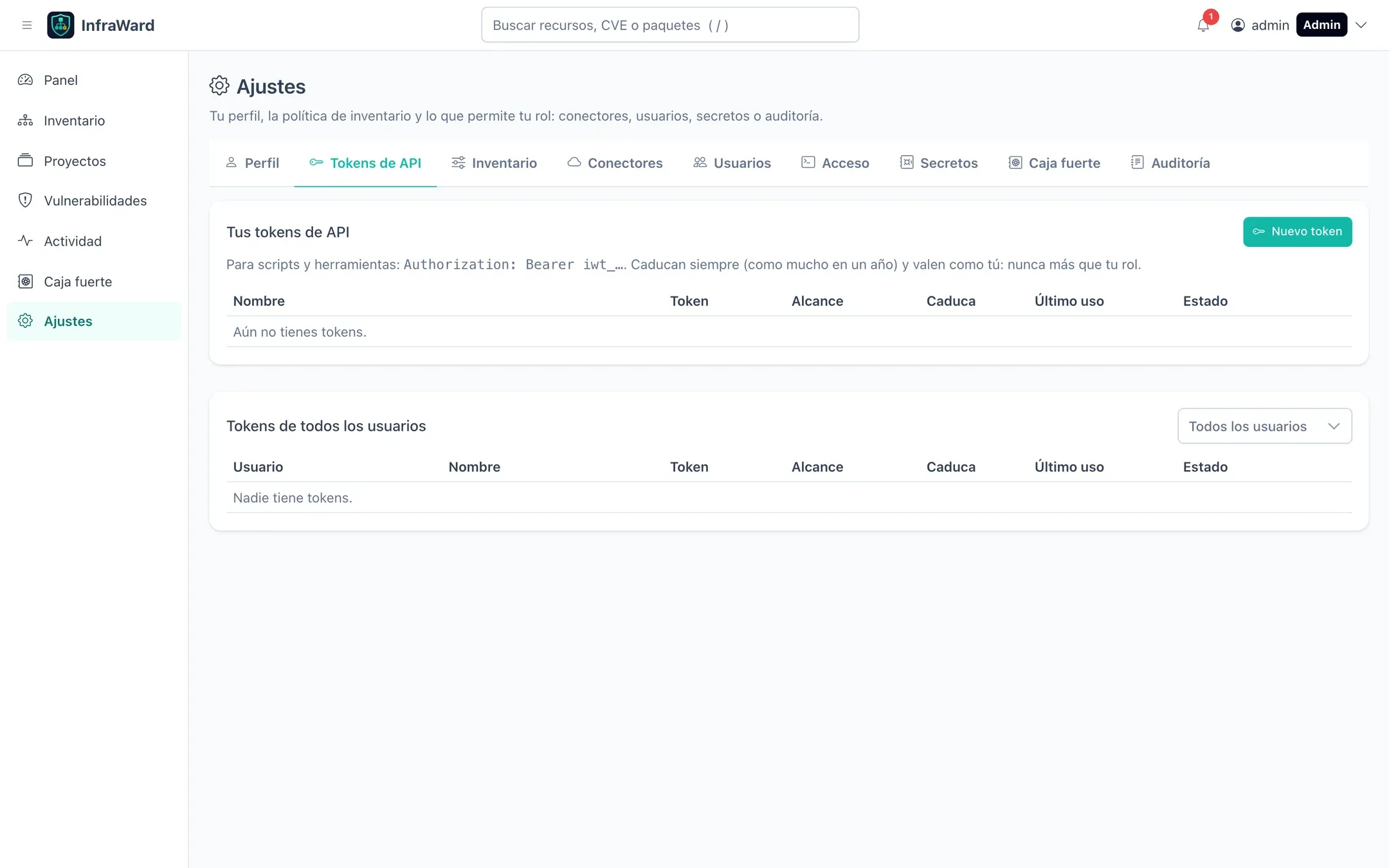
The token is shown once. It starts with iwt_, so secret scanners can recognise it. Only its SHA-256 hash is stored. Each user can have up to 25 active tokens. Creating a role token requires re-authentication. Administrators see and can revoke every user’s tokens.
Send it in the Authorization header:
export INFRAWARD_TOKEN=iwt_...curl -s -H "Authorization: Bearer $INFRAWARD_TOKEN" \ "https://infraward.example.com/api/assets/tree?q=tag:prod"A token never has more permissions than its owner. If the owner’s role changes, the token follows. Deactivating the account, resetting its password or changing it revokes all its tokens. Some endpoints (changing your password, managing tokens, managing users, revealing vault passwords) require a browser session and reject tokens with session_required.
Examples
Section titled “Examples”Urgent vulnerabilities that are in CISA KEV:
curl -s -H "Authorization: Bearer $INFRAWARD_TOKEN" \ "https://infraward.example.com/api/vulnerabilities?minPriority=urgent&kev=true"{ "items": [ { "vulnerabilityId": "CVE-2026-111497", "severity": "HIGH", "fixable": true, "priority": { "score": 100, "band": "urgent", "reasons": [{ "code": "kev" }, { "code": "epss", "epss": 0.55483 }, { "code": "port", "ports": [80] }] } } ], "total": 1, "hidden": {}}minPriority accepts low, medium, high and urgent.
Export the production servers to CSV:
curl -s -H "Authorization: Bearer $INFRAWARD_TOKEN" \ "https://infraward.example.com/api/assets/export?format=csv&q=tag:prod" -o prod.csvThe q parameter takes the same search syntax as the interface.
Errors
Section titled “Errors”| Status | Body | Meaning |
|---|---|---|
| 400 | message lists the invalid parameters |
Validation error. |
| 401 | Unauthorized |
Missing, expired or revoked token. |
| 403 | code: api_token_read_only |
A read token tried to write. |
| 403 | code: session_required |
The endpoint only accepts a browser session. |
| 403 | other | Your role lacks the permission. |
| 429 | Rate limit. Retry later. |
OpenAPI reference
Section titled “OpenAPI reference”The API publishes an interactive reference at /api/docs and the OpenAPI document at /api/openapi.json. In production they are disabled by default. To enable them, set DOCS_PUBLIC=true on the api service (see Configuration variables). They are served without authentication when enabled, so consider leaving them off on Internet-facing instances.
Browser sessions
Section titled “Browser sessions”The web interface uses a session cookie and a CSRF token instead of API tokens. Scripts should not imitate it: use tokens.